
ATHLETE BLOG LEOMINSTER
Innovative Training To Smash Your Vertical Jump Record
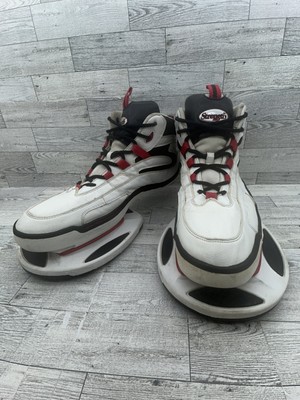
Today's basketball and volleyball players who obsess over their vertical would've loved the old Strength Shoes.
Debuting in the 1990's, Strength Shoes had an elevated platform under the front side, maintaining a constant tension on your calves and achilles tendon.
By wearing them when doing agility drills, the added strain on your lower legs, or 'jump muscles', would let you defy gravity in mere weeks.
Or so their marketing team told you.
Cool idea, and not entirely off base.
But they didn't attack the real jump muscles, the ones more involved in your launch potential - the hips, hamstrings and quads.
The general concept of the Strength Shoes was dead on, training with extreme levels of isometric tension is proving to be the best way to skyrocket your vertical jump.
How does this work in practice?
Naturally, lots of jump training is needed, just like you sprint to get faster or lift weights to get stronger.
Within each repetition lies a secret weapon, your landing position, an often overlooked aspect of how your body grows and adapts to jump training.
Ideal landings are in a parallel squat position, meaning your hips are as low as your knees.
And you want to freeze instantly at that proper depth, not allowing your hips to sink even 1" when your feet hit the box, or ground.
This combination creates an isometric stress on all your backside muscles, the hamstrings up through the hips, exactly like how Strength Shoes work for your lower legs.
In time, this tightens the muscles and tendons which stretch as you drop down to your takeoff position, like thickening a rubber band, so your return upwards launches you into the air with more force.
Is this concept truly innovative?
Probably not, but the fact that most athletes only focus on jump height makes it a major developmental advantage to those who do it right.
Even heavy strength training doesn't have as great of an impact as proper isometric work.
You can take this concept further by eliminating the jump and just dropping from height, perhaps a height higher than you could jump.
This overloads the landing stress, as would adding some sort of resistance to accelerate the drop speed, like bands or weights.
Vertical based sports like basketball and volleyball have an obvious need to train in this fashion.
But jumping is a skill that highly correlates with faster sprinting, skating, and kicking power.
Which means increasing your vertical will have a positive impact on your performance in any team sport.

Power Source Reviews
Level Up Your Game
We can accelerate your speed, strength & athletic development gains
Click the button to start your journey
The Best Youth Personal Training In Leominster, Sterling, Lancaster and Princeton


© Copyright 2026. Power Source. All rights reserved.
|